


Each of us, even if we are completely healthy, can be a hidden carrier of a mutation in at least one of our genes. If both partners are carriers of a mutation in the same gene, they can both pass this mutation on to their child. A mutation acquired from both parents will manifest as a severe autosomal recessive (AR) disease. Some mutations with a recessive type of inheritance are transmitted only by women (genes are located on the X chromosome, XR inheritance) and the disease will only fully manifest itself in their sons if they pass the mutation on to them.
CarrierTest investigates
Hidden carrier of more than 2,000 common mutations causing over 80 genetic diseases and conditions that can affect the offspring of healthy carriers.
Who is CarrierTest suitable for?
For all partners before planning for a child, especially if they are:
infertility
repeated miscarriages or IVF failures
positive history of hereditary disease in one of the partners or in the family
consanguineous marriages
within IVF we test anonymous gamete donors to select the most genetically suitable (compatible) donor for the recipient.
The CarrierTest result report has these parts:
transmission of gene mutations associated with serious diseases of a child
mutations of a panel of genes increasing the tendency to blood clotting (thrombophilic profile)
response to hormonal treatment of infertility
(polymorphism of the FSH receptor gene)
Tested genetic diseases:
CarrierTest identifies the risk of the most common genetically determined diseases, such as:
cystic fibrosis
neuromuscular diseases (e.g. spinal muscular atrophy,
Duchenne muscular dystrophy)
inborn errors of metabolism (e.g. phenylketonuria)
visual and hearing disorders
diseases of the musculoskeletal system and skin
disorders of sexual development and fertility
disposition to blood clotting (thrombophilic profile)
response to hormonal therapy
Results of CarrierTest
CarrierTest reliably excludes or confirms the presence of key mutations. We call key mutations those that are a proven cause of hereditary diseases and for which the test is prepared. However, it does not exclude the transmission of all possible deviations in the genes under investigation. A negative result therefore means that the risk of transmission is significantly reduced. For each gene, a “Residual risk of transmission” can be determined, from which the resulting risk of affecting the child is derived.
What will you learn from the test and why are the results from CarrierTest so valuable?
From the results of the genetic CarrierTest, you will learn whether your descendants are at risk of developing one of the most common genetic diseases that can be hereditary.
Hover over the couple pictures to learn more

No mutation in both partners: the risk of the child being affected by the tested diseases is very low (almost eliminated).

Mutation of a certain gene in only one of the partners: the risk of the child being affected by this disease is low.

Mutation of the same gene in both partners: the risk of the child being affected by this disease is significantly increased (25%). A reproductive geneticist will explain the possible solutions to you during the consultation.
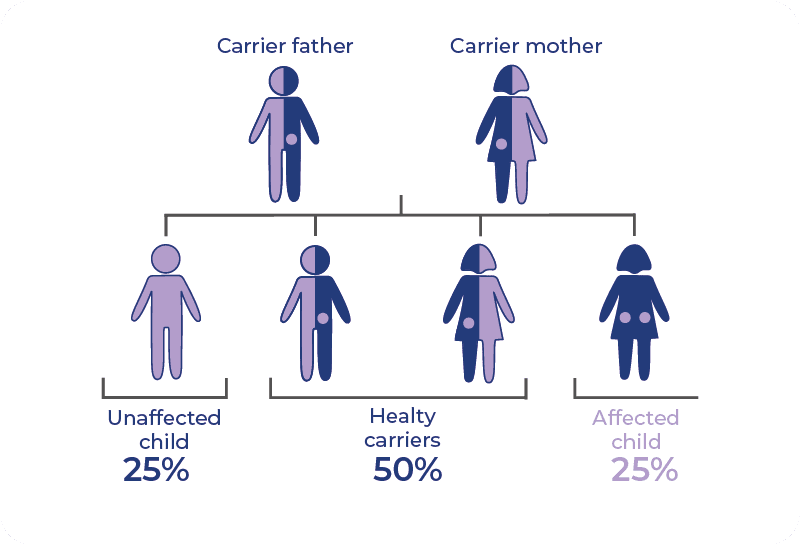
Autosomal recessive (AR) inheritance:
both parents are carriers
If both parents are AR carriers, there is a 1 in 4, or 25%, chance of having an affected child.
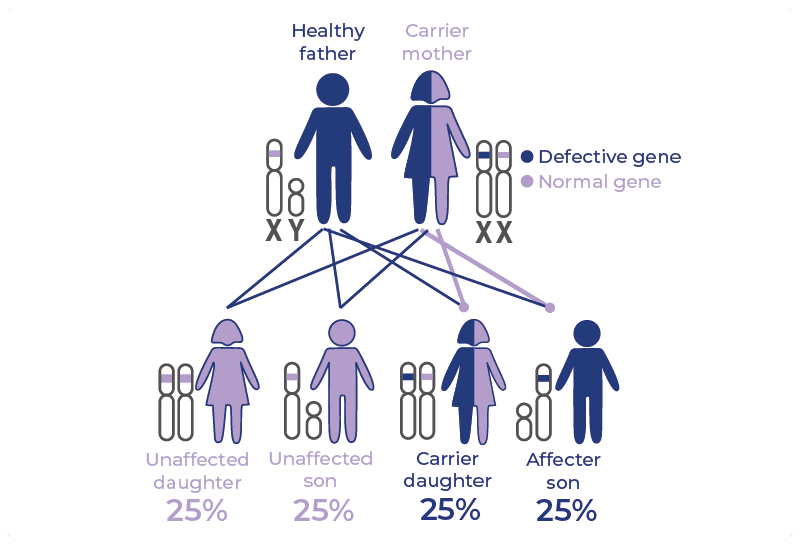
X-linked recessive inheritance:
mother carrier
A mother who is a carrier of an X-linked recessive disorder has a 25% risk of having a son affected by the disease and a 25% risk of having a daughter who is a carrier.
How the examination is carried out and payment
Initial consultation
Blood collection
Final consultation of results with a clinical geneticist including a care plan before and during pregnancy
In indicated cases, the examination is covered by health insurance, if you have it

CarrierTest
One partner 14,000 CZK
Both partners 25,000 CZK


Longenevity s.r.o.
Služeb 4
108 00, Praha 10
Česká republika
Try our other tests

